- "When [condition] the [device] MUST [do something]."
- Business drivers behind requirements management.
- Writing rules to follow.
- Broader systemic challenges to be faced.
- Slides (cleaned for public release).
- Video (23 mins).

“I’m very pleased and proud to receive a Google Open Source Peer Bonus award. I was nominated for my contributions to The Good Docs Project where we are creating technical writing templates to help other projects create high-quality documentation. I’m passionate about the work we’re doing there, and have been hanging around the project since its inception in 2019. This is a friendly, inclusive community creating a safe space for folk to dip their toe into open source. We are global, and new folk are always welcome.”
“I've been actively working on open source projects since my time at NIST with the FDS project starting in 2006. More recently with The Good Docs Project (TGDP) since 2020. It's been a very rewarding experience to contribute to TGDP, with such an amazing diversity of participants, perspectives and interests involved. To be given recognition through the OSPB program was a pleasant and unexpected surprise. While it's not at all what I am participating in the project for, it feels great to have someone else in the project bring my name up for this award. Thank you to TGDP and to Google for this honor.”
Just enough info,When it is needed,To support a specific action,At the quality required.
Congratulations to five templatateers from The Good Docs Project for your Open Source Peer Bonus award from Google. This cool award enables Google employees to recognize and thank a few valued open source contributors. It includes a token financial contribution - enough to take the family out for dinner at a nice restaurant.
Gayathri, Chris and Nelson have been peer-writing open source documentation templates within our EMEA-APAC working group. This includes:
Carrie has grown into a key role in within The Good Docs Project:
Deanna Thompson is an experienced technical writer who plays an impactful role within The Good Docs Project.
Cycle from Curl Curl beach back to Forestway via bike paths, back streets, and a short stretch of dirt trail.

Why am I addicted to open source docs?

Want a quick, 20 minute, pleasant and safe bicycle route from Frenchs Forest down to Warringah Mall? Try this:
Cycle from Frenchs Forest down to Warringah Mall via bike paths, back streets, and a short stretch of dirt trail.
Enjoy the journey!
Within non-trivial technical projects, it helps to have a common language to describe "good":
This page suggests a feature quality scale, along with how it can be applied.
A quality scale can be applied to:
| User experience | Description | Requires | |
| Qx | Over-deliver | * Functionality cannot be noticed or used by the user. | |
| Q5 | Delight | * Anticipate user desires, and provide it. | * Understand the user’s desires and passions. |
| Q4 | Impress | * Anticipate user unanticipated needs, and provide it. | * Analyze the user behaviors and needs. * Understand the product capabilities. * Establish critical user journeys. |
| Q3 | Satisfy | * Meet user’s known wants. | * Listen to the user’s asks. |
| Q2 | Underperform | * Under specified or poorly implemented. * User experience includes many micro-frustrations. |
* Meet purchasing authority’s specification. * Cost saving implementation. * Minimal testing. |
| Q1 | Not practically functional | * While the product “works” the experience is so poor that the user chooses to use something else if available. | |
| Q0 | Broken | * Functionality doesn’t work at all. |
Possible quality scale
For each feature, a project can define quality categories.
| Feature | Delight | Impress | Satisfy | Underperform | Not practically functional | Broken |
| On/off button | Works | Fails | ||||
| Waterproof to | > 100m | > 10m | > 1m | < 1m | ||
| Uptime | > 99.999% | > 99.99% | > 99.9% | > 99% | > 90% | < 90% |
Example quality criteria
Note: Many features won't need the full scale.
The importance of each quality criteria will vary depending upon:
Phase: Alpha release
| Feature | Priority | Should | Must | Error tolerance |
| On/off button | P1 | Satisfy | Satisfy | Satisfy |
| Waterproof | P3 | Impress | Underperform | Broken |
| Uptime | P2 | Impress | Satisfy | Underperform |
Example phase exit criteria
The criteria can be converted into traditional requirements:
| The device | should | be waterproof to 100m. |
| The device | must | be waterproof to 1m. |
Terminology from the quality scale can be aligned with bug severity levels. Severity can be driven by impact to the user, or impact to the business.
| Severity | User Impact | Business Impact |
| S4 Trivial | * P3 feature underperforms | * Person days to fix. |
| S3 Minor | * P3 feature is broken * P2 feature underperforms |
* Person weeks to fix. |
| S2 Major | * P1 feature is broken, with work-around * P2 feature is broken, no work-around |
* Person months to fix. |
| S1 Critical | * P1 feature is broken. No work-around. | * Upcoming releases blocked until fix provided. |
Example severity scale

Alyssa has played a pivotal role in growing and expanding, The Good Docs Project. She has been doing this by:
Angelos has been a lynch pin contributor to many of the geospatial open source projects. Most notably, he is one of the primary coordinators of the OSGeo-Live linux distribution of open source geospatial software, supporting the 50+ projects represented to get the software up to scratch and compiling on the distribution. He is very competent, always humble, very wise, always supportive of others, and very effective at building open source communities. Notably, he has been voted onto the board of the Open Source Geospatial Foundation.
Aidan has been a steady and reliable contributor to The Good Docs Project, taking on core background tasks, like community building (kicking off an unofficial welcoming committee for new members), and setting up a base template working group (from which all of the rest of our project templates will depend.) He takes on the unglamorous but important work which makes an open source project successful.
 |
| Big Ben clock |
So we've added a timeless documentation section to the Google developer documentation style guide. Timeless documentation is documentation that avoids words and phrases that anchor the documentation to a point in time or assume knowledge of prior or future products and features. So while it is okay to reference "a new feature" in news article; "latest" or "new" shouldn't be used in reference docs. The content becomes outdated soon after publication.
You can read more about it in the Google developer documentation style guide.
TS;DR (Too Sarky; Don't Read)

Dear cyclists,
For your health and safety, please ensure that you always dismount and walk your bicycle to the car park's bike cage.
Thank you and stay safe,
Office facilities.
So here is my response:
Dear facilities,
On my ride to work I encounter:And in the last 50 metres of my ride, travelling at walking speed into a quiet car park, where the worst that could happen is I might slip on polished concrete and bruise a hip; at that point my employer becomes concerned about my safety and encourages me to walk my bike?
- Squeeze points on main roads shared with cyclist killing machines,
- Stressed and agro peak hour traffic,
- Super slippery road plate,
- Unmaintained and destabilizing bike paths,
- I could go on ...
(This is not a complaint, or an ask for action. Just an opportunity to share in the humour of the situation.)
One of your friendly cyclists.

The Good Docs Project is about to run a series of one hour workshops to brainstorm:
We'll start around March 17, 2021. If you’d like to contribute, please vote for your preferred time slot and help us understand how many people will attend: Doodle poll.
Feedback will be used to update our base template, and set the direction for future template development.
Pre-reading:
Session 1: Overview
Session 2,3: Topic discussions
Participate if:
To date:
Within The Good Docs Project we are creating best practice templates and writing instructions for documenting open source software.
In our first release in 2019, we’ve created 0.1 core templates, based on insights from multiple senior tech writers. These are quite good, but in the interim we’ve been improving these templates, building up processes, and refining our thinking about what makes a good template.
This has accumulated into our current base template docs. As of March 2021, these docs are draft ready, but untested.
This phase (first half of 2021):
Next we are inviting tech writers to adopt and create a template from our prioritized wish-list of templates to write. We will be testing our base template by using it - and we will collect feedback into the base template.
Adopting a template is a reasonable commitment, but is achievable for one person to tackle. It involves:
We’ll move through stages of:
At the end of this push, we expect to have a more consistent, core set of templates, along with a bunch of lessons to roll into future phases.
Future:
In future:
Google has an awesome mission statement:
"To organize the world's information and make it universally accessible and useful."
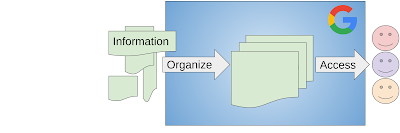
Its hard not to feel inspired by this. What a valuable gift to the world! But I think it could be even better. Because this mission statement only kicks in after ideas have been written down, as “information”.

"Create best practice templates and process for open source software."
Here is a beautiful ride from Manly to Frenchs Forest using only quiet backstreets, cycle paths, tracks and fire-trails.
This interim status report outlines achievements, early findings and outstanding tasks for our cross-organizational glossary pilot project.
Glossaries are easy to set up for simple examples but extremely hard to scale - especially when a project wants to inherit terms from other organizations. This pilot has been set up to test cross-domain management of glossaries. We started in August 2020, and plan to have tested pilot goals by March 2021.
We are testing glossary software, standards, and processes, and applying them to cross-organizational use cases within the geospatial mapping domain.
For more details, refer to our manifesto.
Pilot contributors: Cameron Shorter, Alyssa Rock, Ankita Tripathi, Naini Khajanchi, Ronald Tse, Reese Plews, Rob Atkinson, Nikos Lambrinos, Erik Stubkjær, Brandon Whitehead, Ilie Codrina Maria, Vaclav Petras
Our interim status as the start of December 2020 is as follows:
| Task | % Complete |
| Define glossary goals | 90% |
| Establish implementation Plan | 80% |
| Establish a healthy community | 70% |
| Implement/adopt software platform | 70% |
| Establish schemas for terms | 70% |
| Define sentence structure for terms | 70% |
| Connect external glossaries | 10% |
| Collate and clean Open Source Geospatial (OSGeo) terminology | 60% |
| Document template governance processes | 10% |
Task: Define glossary goals.
Understanding the problem is the first step needed to then address it.
Figure: Connected glossaries, source
Status:
Task: Establish implementation Plan
Status:
Task: Establish a healthy community:
Apache, one of the leading open source foundations prioritizes “community over code”. A strong community will solve any technical challenges faced.
Status:
Outstanding:
Task: Implement/adopt software platform
Status:
Task: Establish schemas for terms
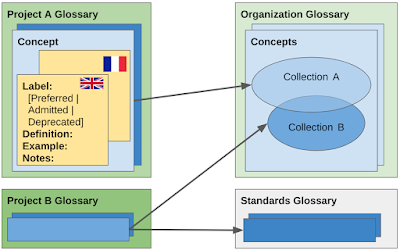
Figure: Glossary schema, sourcing from upstream glossaries, source
Status:
Task: Define sentence structure for terms.
Status:
Task: Connect external glossaries
Status:
Task: Document template governance processes

Figure: Glossary governance, source
Status:
While we have been discussing and making use of our own unwritten governance process, we are yet to write this down and provide it as template guidance.
Task: Collate and clean Open Source Geospatial (OSGeo) terminology
Status:
Jo Cook and Jared Morgan have been presented with awards for Google's Open Source Peer Bonus Program. The award is a recognition and thank you to people who go above and beyond in their contributions to open source. It also includes a token financial contribution - enough to take the family out for dinner at a nice restaurant.
Well done Jo and Jared, you really deserve it:
 |
| Jared Morgan, Write the Docs podcast host |
Jared is a core contributor and community builder within The Good Docs Project. As an experienced technical writer, he has contributed to many of our initial set of writing templates and then helped absorb feedback from our community. He is well respected and well connected within the technical writing community, helping to inspire other thought leading technical writers to come and join us.
This year, 2020, he has signed up as a Season of Docs mentor for The Good Docs Project.
In a related activity, he has also helped spread knowledge within the technical writing community, by co-hosting the Write the Docs podcast.
 |
| Jo Cook, explaining docs at DevRel conference |
Jo is an enabler of open source communities. She commits large chunks of her volunteer time to working on the hard problems that others don't tackle. She is someone you can rely upon when needed, and she steps back when her skill-sets are more valuable elsewhere.
A few highlights of her volunteer activities over the last couple of decades include: |
| Image by Chris Dlugosz |
Glossaries are easy to set up for simple examples but very hard to scale - especially when you try to scale across use cases, across domains and across organisations.
We are kicking off a pilot project to address cross-domain management of glossaries and preferred word lists. The pilot will build processes and tools for the generic use case, developing and applying them within the geospatial mapping domain.
Communication about this document will be on the OSGeo Lexicon email list. (Check your spam for confirmation email after subscribing.)

