Critical Mass - Sydney
What has it become?
July 1998
 |
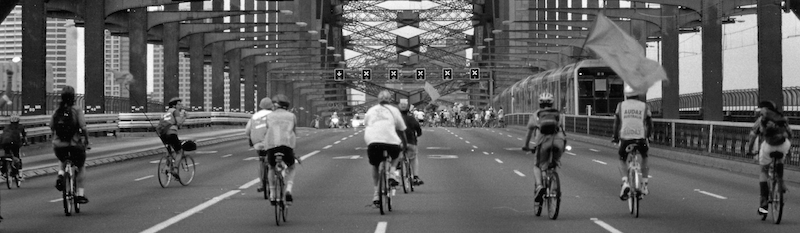
| Critical Mass Bicycle Riders promote clean air on the Sydney Harbour Bridge, during Kyoto Climate Change Summit, November 1997. Photo by Matthew Whitaker |
A few days before the Kyoto conference on climate change in November 1997, an estimated 750 cyclists and roller bladers filled all eight lanes of Sydney Harbour Bridge during peak hour traffic. This was the most dramatic, and most publicised action of critical mass to date. It was a desperate attempt to show how cycling can be used as a form of transport.
The ensuring media coverage, both positive and negative, is credited with having contributed to opening direct dialogue between Carl Scully, Minister for Roads and Transport, and cyclists. Soon after, the minister's office announced two new senior positions dedicated to cycling within the Roads and Traffic Authority (RTA). Critical mass has become media worthy, which translates to political clout.
Public pressure, a combination of Bicycle NSW lobbying, and plain old-fashioned embarrassment created by critical mass, has proved to be a powerful, complimentary combination.
Redefining protesting
Critical mass is more than a traditional protest where participants are reduced to being passive observers of a spectacle. It is a demonstration of how our cities can run without cars, it is leading by example, it is talking to the public on a one to one basis as the mass rolls past, it is making a political statement while taking part in a fun event. Cycling, roller blading, music, friends, and a good meal afterwards. For many, critical mass has become a social occasion.
As critical mass has grown, so too have the activities riders involve themselves in. Now, when people mention critical mass they often mean, putting cycling and public transport on political agendas, assisting local councils develop bike routes, writing letters to papers, calling talkback radio, sending out press releases, giving interviews, setting up publicity stunts, painting banners and tee shirts, printing fliers and posters, creating web pages, coordinating listservers, repairing and recycling bicycles, conducting media and non-violence workshops, networking, videoing and photographing, giving legal advice, communicating with police, setting up a low-range FM radio station, building a pedal powered sound system. The list is by no means exhaustive and is limited only by the imagination.
Critical mass's power structure is unique in the way it is organised. Conspicuously absent is any reminder of the daddy-knows-best patriarchal model. No one is in charge, everyone decides their own destiny. It is not a democracy, although spontaneous voting sometimes take place on issues such as route choice before the ride. Suggestions and criticisms are encouraged, but the people who to do the work generally get to decide how it is done.
What has had extraordinary appeal and has marshalled the efforts of dozens of volunteers seems to have been precisely that there are no leaders. There is no need to wait for the next club elections to be voted into a position of power, and people do not need to commit themselves to a year of service before they have the opportunity to do anything.
For example, at Gabrielle's first critical mass meeting, she took on writing the press release for the following ride. Brendan, who has the gift of the gab and a mobile phone, started ringing radio stations during his second ride. Andrew felt there was too much agro on the mass, so volunteered to organise a non-violence workshop. Sure, he didn't have experience in non-violence or critical mass, but it was fairly easy to find people that were and it just needed someone to coordinate it.
Cutting edge activism
After the one to one interaction of the mass, email listservers and the web are our primary form of communication. A list server receives email messages from subscribers and then routes the message to everyone on the list.
A listserver can be like a newsletter, only there is no folding and posting, no buying of stamps, envelopes, and paper, no maintaining lists of addresses, no formatting and editing. Listservers are cheap so no volunteer time waisted collecting money from members. Basically list servers are less work and hence volunteers have time to do more constructive things.
Listservers don't have to wait for a newsletter deadline, so you can send news out as often as you want. Consequently, the listserver is an excellent way to mobilise lots of people fast. When Tollaust tried to discourage cyclists from using the M2 motorway by charging them as much as cars, 130 cyclists organised a protest in a week using email as the main form of communication.
A listserver can be like an on-line meeting, with many advantages. A meeting with fifteen or more people often turns into a rabble, with only the loud, domineering people getting heard over the rest. A listserver provides everyone with equal opportunity to partake in discussions. This has moulded well with the leaderless structure of critical mass. If you do get a ramble, you can skim their message and delete it, a bit like fast forward someone in a meeting. Because people write more precisely than they talk, more people can fit in an listserver discussion. No time is waisted travelling to the meeting, and people can partake at a time convenient for them. Consequently, we have twenty times as many people on our listserver as we have at critical mass meetings.
When people take part in developing an idea, they are likely to help put the idea into practice. With so many people on our listservers we have been getting lots of great ideas, and more importantly, lots of volunteers.
Issues can be discussed as they arise rather than waiting a week or two for the next meeting.
Lately, people have been writing letters to newspapers, politicians, and government agencies, and copying the them to the list. Each witty letter seems to encourage others to write themselves, and an unofficial letter writing campaign has started.
International conferences are as easy as communicating with people in your own city. We regularly talk with critical mass participants around the world.
No resources are wasted taking minutes. That is handled by a list archive.
Our critical mass web pages have taken on the role of library, storing fliers, posters, tips on cycle activism, and of course, everything there is to know about critical mass. The convenience is that anyone can access the data from home.
Runs on less than the smell of an oily rag
Critical mass runs on voluntary labour. Banners are printed at cost price by cycling printers, cycling lawyers give free advice, computer programmers build web pages and maintain list servers. Raw materials have been paid for by selling video footage and tee shirts, and the occasional donation from bike shops.
Because there are no organisers, there is no need to insure against legal liability. Each cyclists is responsible for their own well being, just as they are when they are cycling home from work. And if some testosterone pumped rev-head decides your back wheel needs rearranging, there are always a few hundred sympathetic witnesses to choose from.
No cost and minimal organisation has helped maintain critical mass's autonomy and sustainability. Here is a movement that will not be bought, or influenced, or go away until 750 cyclists ride around the city for an hour and a half and nobody notices.
What next?
Critical mass has doubled in size every year. With size comes media interest, and the ability to influence political agendas. Like green movements before us, the radical ideas proposed by critical mass will become main stream, and critical mass is likely to develop a more conservative image. If we are successful, Sydney will get its bikes paths and other transport alternatives, but we still have plenty of lobbying ahead of us. The success of critical mass is dependant upon us, the riders.
About the author
Cameron Shorter is 29, a computer programmer, commuter cyclist, and critical mass rider. He has coordinated publicity stunts, and given numerous interviews about critical mass over the last two years.